


What You'll Need Before You Start Brewing
Brewing loose leaf tea well starts with a few simple tools. This guide from Grand River Tea covers the essentials, and most kitchens already have half of them.
Here's the short version of what matters most:
- A kettle for heating water
- A brewing vessel (teapot, mug, or gaiwan)
- An infuser, strainer, or sieve
- A teaspoon or small scale for measuring
- Fresh, filtered water
Understanding the Loose Leaf Tea Brewing Ratio
The loose leaf tea brewing ratio is the amount of tea leaves you use per cup of water. Get this right, and everything else gets easier.
Measuring by Weight vs. Volume
Weight beats volume every time. Here's why: a teaspoon of fluffy white tea weighs far less than a teaspoon of dense rolled oolong.
- By weight: 2-3 grams per 250 ml is a solid baseline
- By volume: 1 teaspoon per 250 ml works for most teas
- For large-leaf herbals: use a bit more, since the leaves take up space
Water Temperature and Tea Steeping Times Chart
Water temperature and steeping time decide whether your cup tastes sweet or bitter. Temperature controls which compounds dissolve into the water; time controls how much of them end up in your cup. Get both roughly right and even an inexpensive tea tastes clean.
Use this chart as your starting point.
|
Tea Type |
Water Temperature |
Steeping Time |
|---|---|---|
|
White tea |
75-80°C |
2-3 minutes |
|
75-85°C |
2-3 minutes |
|
|
Oolong tea |
85-90°C |
3-4 minutes |
|
Black tea |
95-100°C (full boil) |
3-5 minutes |
|
Herbal tea |
100°C (full boil) |
5-7 minutes |
Why Temperature Matters More Than You Think
Tea leaves contain three main groups of compounds, and each dissolves at a different rate:
- Amino acids and L-theanine dissolve first, even in cool water. These give tea its sweetness and savory depth.
- Caffeine and catechins dissolve next, starting around 70-80°C. These give structure and a pleasant bite.
- Tannins dissolve most readily above 90°C and with long steeps. These give astringency and, past a point, bitterness.
Visual Cues When You Don't Have a Thermometer
No thermometer? Watch and listen to the water instead. The tea preparation guidance from the Tea Association of Canada notes that water goes through clear stages as it heats.
- Small bubbles clinging to the bottom and sides: roughly 70-80°C. A few wisps of steam. Ready for green and white tea.
- Bubbles rising steadily in a column: roughly 80-90°C. Steam visible. Good for oolong and lighter black teas.
- Full rolling boil: 100°C. Heavy steam, audible rumble. Use for black and herbal tea.
Matching Your Kettle to Your Tea
Not all kettles are equal for temperature control:
- Stovetop kettle: No temperature readout. Rely on the visual cues above, or use the cool-vessel trick.
- Standard electric kettle: Boils fast but usually only to 100°C. Same workaround applies.
- Variable-temperature electric kettle: Lets you dial in 70°C, 80°C, 85°C, and so on. The single biggest upgrade for anyone brewing green or white tea regularly.
- Gooseneck kettle: Not about temperature, about pour control. A slow, steady pour over the leaves gives more even extraction than a fast dump, especially in a gaiwan or small teapot.
If you brew mostly black and herbal tea, a basic kettle is fine. If green, white, or oolong are regulars in your rotation, a variable-temperature kettle pays for itself in fewer ruined cups.
Adjusting for Altitude and Hard Water
Two kitchen variables quietly change your results:
- Altitude: Water boils at a lower temperature the higher you go, roughly 95°C at 1,500 m and about 90°C at 3,000 m. If you live at elevation, your "full boil" is cooler than the chart assumes, so add 30-60 seconds to black and herbal steeps.
- Hard water: High mineral content, especially calcium, mutes flavor and can leave a chalky film on your cup. If your tap water is hard, filtered or bottled water makes a noticeable difference in the same tea brewed side by side.
Let boiled water sit for a minute or two to cool before pouring it over delicate leaves.
How to Brew Tea Without an Infuser
You can brew loose leaf tea without an infuser using three easy methods. No special equipment needed.
- The two-cup pour: Steep leaves directly in one cup, then pour through a small strainer into a second cup.
- The teapot and sieve: Brew in any teapot, then pour through a fine sieve into your teacup.
- The French press: Add leaves, pour water, steep, then press the plunger down to trap the leaves.
Step-by-Step: How to Brew Loose Leaf Tea
Follow these seven steps for a reliable cup every time. Total time: about 6 minutes.
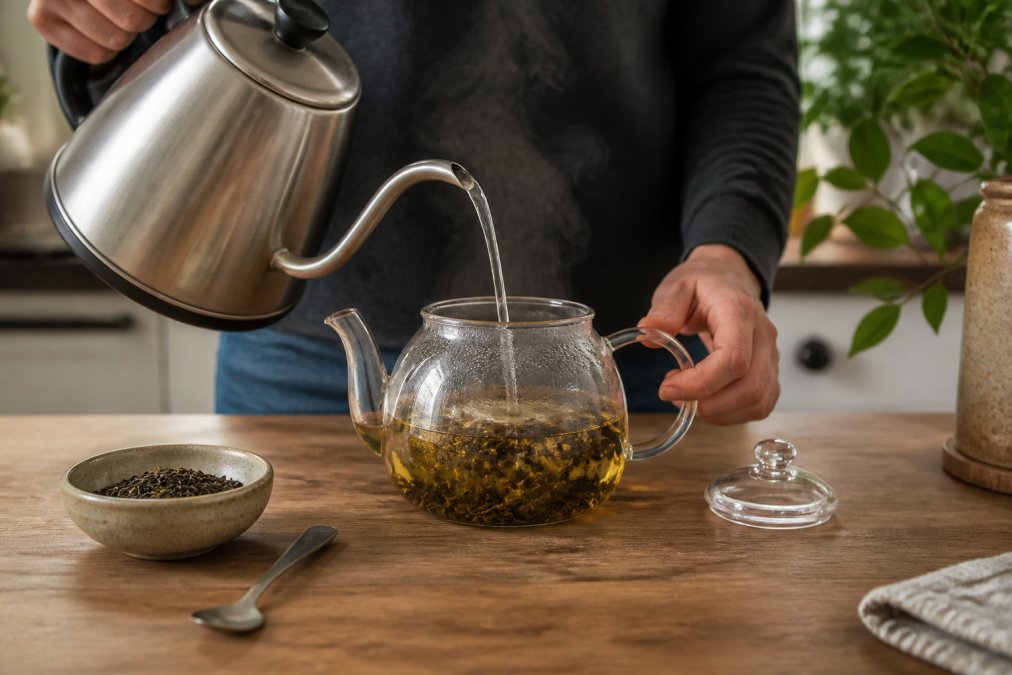
- Heat your water to the right temperature for your tea.
- Measure your leaves (1 teaspoon or 2-3 grams per 250 ml).
- Add leaves to your vessel or infuser.
- Pour water over the leaves and start your timer.
- Steep for the time listed on your tea's chart.
- Remove the leaves or decant the tea into another cup.
- Sip and adjust next time based on how it tasted.
Warming Your Teapot or Teacup
A quick rinse with hot water before brewing keeps your tea warmer for longer. Swirl the water around, then pour it out.
Troubleshooting Bitter or Weak Tea
Bitter tea usually means too much heat or too long a steep. Weak tea usually means too little leaf or water that wasn't hot enough. But the fix depends on which variable is actually off, and changing two things at once tells you nothing. Diagnose first, then adjust one variable at a time.
The Diagnostic Table
|
Problem |
Likely Cause |
Fix |
|---|---|---|
|
Bitter, astringent |
Water too hot |
Lower temp by 5-10°C |
|
Bitter, harsh |
Steeped too long |
Cut steeping time by 30 seconds |
|
Bitter only at the end of the cup |
Leaves still in the vessel |
Decant fully, or remove the infuser |
|
Weak, watery |
Too few leaves |
Add another teaspoon |
|
Weak, flat |
Water not hot enough |
Reheat to correct temp |
|
Weak despite enough leaf |
Leaves too old or stale |
Replace with fresh tea |
|
Dry, puckering |
Over-extracted tannins |
Shorten steep, use less leaf |
|
Metallic or papery |
Poor water quality or stale leaves |
Switch to filtered water, check storage |
Small changes add up. Adjust one thing at a time so you know what worked.
Why Bitterness Happens (and How to Reverse It)
Bitterness is not a defect in the tea, it is tannins and caffeine extracted past the point of balance. Three levers control how fast that happens:
- Temperature. Every 10°C increase roughly doubles the extraction rate of tannins. Dropping from 100°C to 85°C can cut perceived bitterness dramatically without losing body.
- Time. Tannins keep dissolving the whole time the leaves sit in water. A 30-second oversteep at high heat is often enough to tip a cup.
- Leaf-to-water ratio. More leaves means more surface area, which means faster extraction. If you like a strong cup, add leaves and shorten the steep rather than steeping longer.
Why Weak Tea Happens (and Why More Leaves Isn't Always the Answer)
If your tea tastes thin despite using what looks like enough leaf, the cause is usually one of these:
- Leaves are too old. Volatile oils that carry aroma fade within months of opening. Older leaves taste flat no matter how you brew them.
- Leaves are too finely cut. Ironically, very fine tea can extract so fast that it turns bitter before it turns strong. Whole-leaf tea extracts more slowly and more evenly.
- Water is too soft or too hard. Very soft water can taste flat; very hard water mutes flavor. Filtered water is the middle ground.
- The vessel is too small. Leaves need room to unfurl. Cramped leaves extract unevenly, giving you a cup that is both weak and bitter at once.
The Mid-Cup Problem
A common complaint is tea that tastes great for the first few sips and turns bitter by the bottom of the cup. The cause is almost always leaves still sitting in the water. Even after you stop actively steeping, extraction continues. The fix is simple: decant the entire brew into a second vessel, or lift the infuser out completely.
A Note on Re-Steeping and Bitterness
If your first steep was bitter, your second will be worse. Bitterness compounds across steeps because the leaves have already given up their sweetness. If a tea turns bitter on steep two, shorten the next steep by 30 seconds and drop the temperature by 5°C. If it is still bitter, the leaves are spent, start fresh.
Re-Steeping Leaves and Storing Tea for Freshness
Good loose leaf tea can be steeped more than once. Whole-leaf teas often give two to three solid cups from the same leaves.
- Store in an airtight container
- Keep it away from light, heat, and moisture
- Avoid storing near coffee or spices
- Use within 6-12 months for best flavor
Conclusion
Brewing great tea comes down to a few small habits: the right ratio, the right temperature, and a steep time you actually watch. Get those three right, and even a simple mug tastes like something special.
Frequently Asked Questions
What is the ideal ratio of water to loose leaf tea?
The general rule for loose leaf tea brewing ratio is 1 teaspoon (about 2 to 3 grams) of dry leaves per 250 ml (8 oz) of water. For dense teas like rolled oolong or gunpowder green, use a scant teaspoon. For fluffy herbal blends or white tea, heap it. Adjust stronger or weaker to taste. Weighing leaves on a small kitchen scale gives the most consistent results across different tea types.
How long are you supposed to steep loose leaf tea?
Steeping time depends on the tea type. Black tea needs 3 to 5 minutes, green tea 2 to 3 minutes, white tea 4 to 5 minutes, oolong 3 to 5 minutes, and herbal blends 5 to 7 minutes. Over-steeping releases extra tannins, which is the main cause of bitterness. Set a timer for your first few cups, then rely on color and aroma once you know your preferred strength.
Can I just put loose leaf tea in water?
You can, but you will need a way to separate the leaves from the liquid before drinking. Options include a basket infuser, a French press, a tea ball, or simply pouring through a fine mesh strainer into a second cup. Some people add leaves directly to a mug and sip around them, but the tea keeps steeping and turns bitter. Decanting into a fresh cup gives you control over flavor.
Do I need special equipment to brew loose leaf tea?
No special equipment is required. A kettle, a mug, and a fine mesh strainer or sieve will get you a good cup. An infuser basket or French press makes the process tidier. A thermometer helps with water temperature, but you can also use visual cues: small bubbles on the bottom for green tea, a steady stream of bubbles for oolong, and a full boil for black tea and herbals.
Great tea starts with great leaves. Grand River Tea offers small-batch, sustainably sourced loose leaf teas, including Canadian herbals and North American yaupon, with options for both home brewers and wholesale partners. Subscribe now to sip, save, and explore exclusive tea blends, perks, and surprises with Grand River Tea.